

Kenya’s ecommerce story used to be about access: getting more people online, onto apps, and into carts. In 2026, the story is about trust.
At the recent East Africa Digital Commerce Summit 2026, we presented findings that point to the real battleground for East African ecommerce being TRUST. Our report paints a picture of a market that has embraced digital shopping enthusiastically but is struggling to trust some very key aspects of it.
Online Shopping Has Gone Mainstream
The numbers confirm what most retailers already suspect: online shopping in Kenya is no longer a niche behaviour. 75% of respondents have shopped online, and 20% say they rarely set foot in a physical store at all. Consumer electronics (50.5%) and clothing (48.7%) lead as the top online purchase categories, reflecting a market that’s comfortable buying both high-consideration and lifestyle products digitally.
But from where we sit, ecommerce and social commerce are becoming one. Discovery is happening on TikTok, Instagram, and Facebook, questions get asked on WhatsApp, and 74% of shoppers now rely on digital groups and communities to judge social proof before they buy. In other words, digital commerce is becoming a continuous conversation that is taking place across platforms.
Physical Touchpoints Still Matter
Even in a social-commerce-driven market like Kenya, digital discovery doesn’t always end in a digital transaction. Many Kenyan consumers still route their journey through physical verification, from inspecting products in-store to confirming a seller’s authenticity, or collecting orders from a known location. Consumers are moving fluidly between an AI-assisted comparison, WhatsApp queries, and in-person pickups, all as part of a single purchase decision.
The Trust Gap Is a Stack
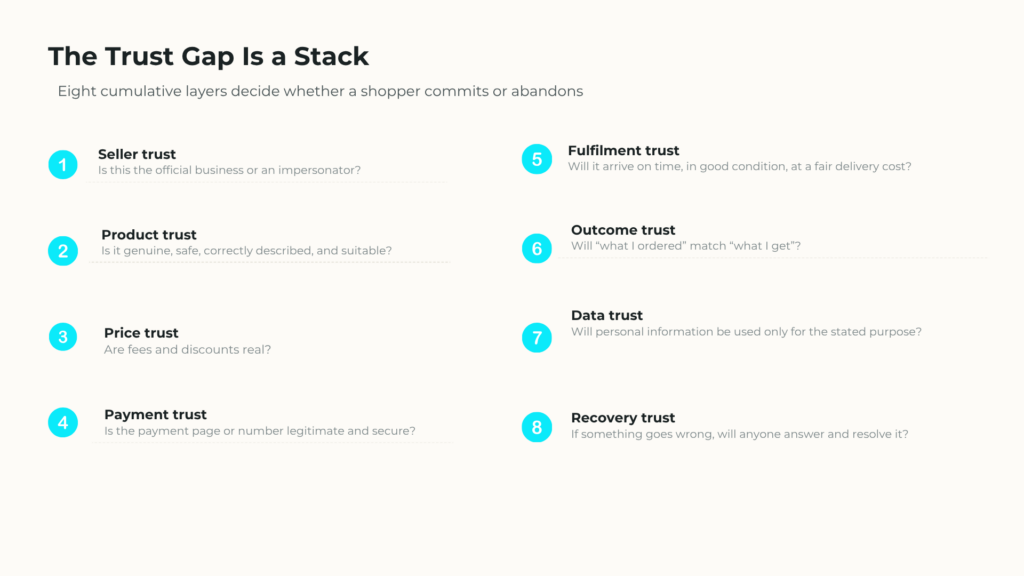
We identified eight cumulative layers that a Kenyan shopper mentally clears before completing a purchase. There’s seller trust, product trust, price trust, payment trust, fulfillment trust, outcome trust, data trust, and recovery trust. A weak link at any layer can stall the sale even if everything else about the offer is compelling.
This stack frames TRUST as something brands can audit and fix, layer by layer.
Counterfeits Are Undermining Confidence
As many as 60% of shoppers have bought counterfeit goods in the past 12 months and 31% of these fake purchases happened on online platforms. Most concerning, 70% of consumers say they simply can’t tell a genuine product from a fake one.
Rising impersonation scams compound the problem, with brands like Jambojet and Kenchic actively running consumer education campaigns warning shoppers to verify official handles, domains, and payment channels before transacting. This is a sign that authenticity verification is becoming a core brand responsibility, not just a consumer literacy issue.
AI Is the New Shopping Assistant
Kenyan shoppers are embracing AI enthusiastically, but with clear limits. 69% have already used AI tools to assist with shopping, and 71% say AI makes online shopping faster and easier. Shoppers are using AI for price comparisons, product discovery, and multilingual conversational support.
As Agentic commerce becomes a reality, shoppers are also starting to trust AI to complete checkout on their behalf. Currently, only 29% would trust an AI agent to act on their behalf.
However, we see AI eventually being used to compare products, build a basket, and execute a purchase within a consumer’s pre-set spending rules.
What Brands Should Take From This
Our report closes with five sharp takeaways for ecommerce players operating in Kenya:
- Adoption doesn’t equal trust: digital reach is outpacing consumer confidence.
- Trust is revenue: security concerns are already driving cart abandonment and platform switching.
- Social is commerce: discovery, influence, and transaction now happen in the same channel.
- AI is reshaping the trust model: consumers want AI’s help, not (yet) its authority.
- Safety must feel seamless: protection can’t come at the cost of convenience.
Brands need to build for the customer’s sense of safety, not just the system’s security. In a market where discovery is instant and skepticism is high, you need to be the seller that consumers trust enough to get to checkout.


