

The Agent-to-Agent Commerce era: When Your Customer’s AI Meets Your AI
Your future customer might never visit your website, scroll your socials or walk into your store. Instead, they may send an AI assistant to do the shopping for them.
Right now, people are asking AI what to buy, comparing products, checking reviews, hunting for the best price and even asking, “Which one would you choose?” The next stage is agent-to-agent commerce, and it will change how brands compete for every sale.
What is agent-to-agent commerce?
Agent-to-agent (A2A) commerce, often called agentic commerce, is shopping carried out by autonomous AI agents. A customer’s personal AI agent communicates directly with a brand’s systems or AI agent to discover products, compare terms and complete a purchase, with little human involvement.
Right now, AI helps customers research. Soon, customers will let it decide. A shopper sets a budget, states a preference, and the agent compares options, picks a product and checks out.
How the customer journey changes
The classic funnel of search, scroll, compare, cart, and checkout compresses into a conversation and an approval. For many everyday categories, the agent will handle repeat purchases and timing in the background and surface only the decisions that matter. Customers will spend their effort setting preferences, reviewing choices and occasionally overriding them, rather than clicking through pages.
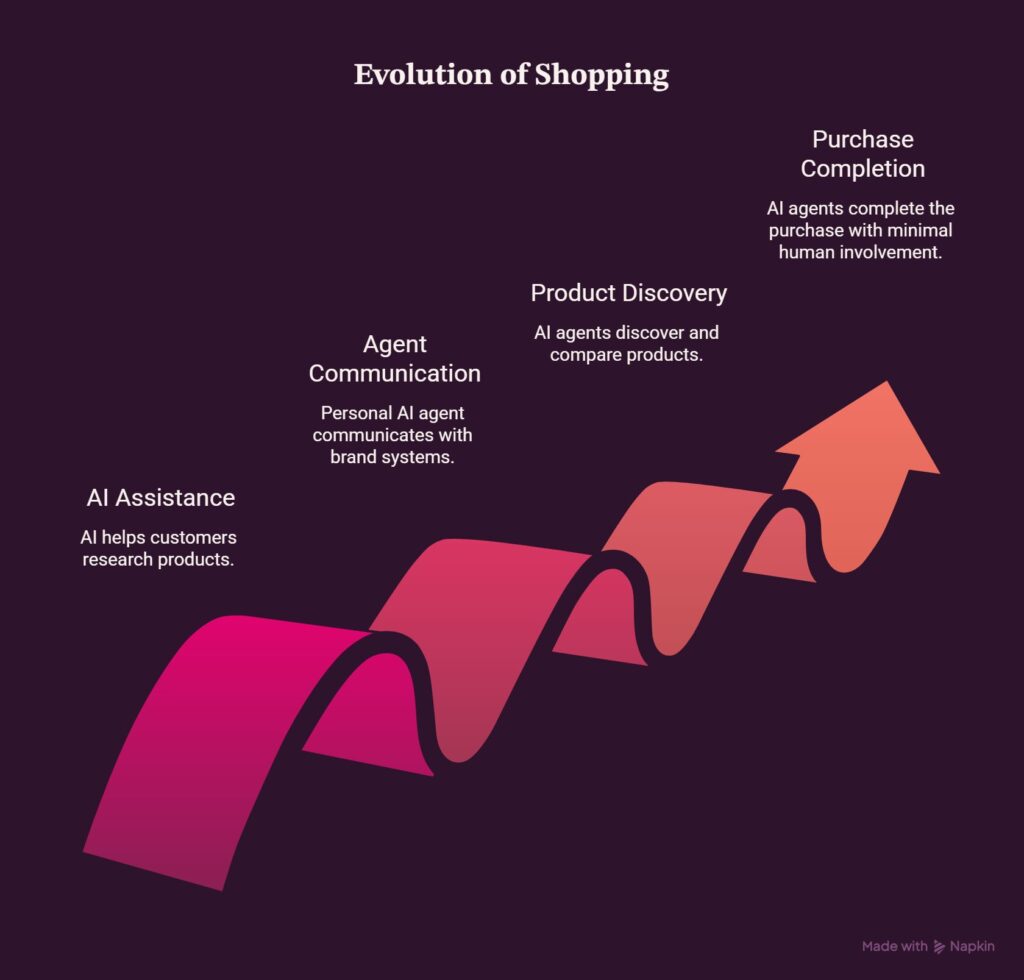
For brands, success shifts from being top of mind to being top of the agent’s rankings. Today’s AI models can also be inconsistent, so agent behaviour may vary from one interaction to the next. That makes preparation even more important.
Why agentic commerce changes how brands compete
For years, brands have competed for human attention through search ads, social content, influencers, and storytelling. In agentic commerce, your brand is evaluated by a system that reads data, weighs trust signals and acts on what it finds.
That means your products will no longer compete only for a customer’s attention. They will compete for the AI’s recommendation. An agent is not moved by a catchy slogan. If a shopper cares about sustainability, the agent will favour the brand that can prove it with data over the one that only claims it.
Loyalty is tested too. If habit and impulse count for less, value, reliability, and fit count for more, and an agent may switch to a competitor that fits a request slightly better.
How forward-thinking brands are preparing
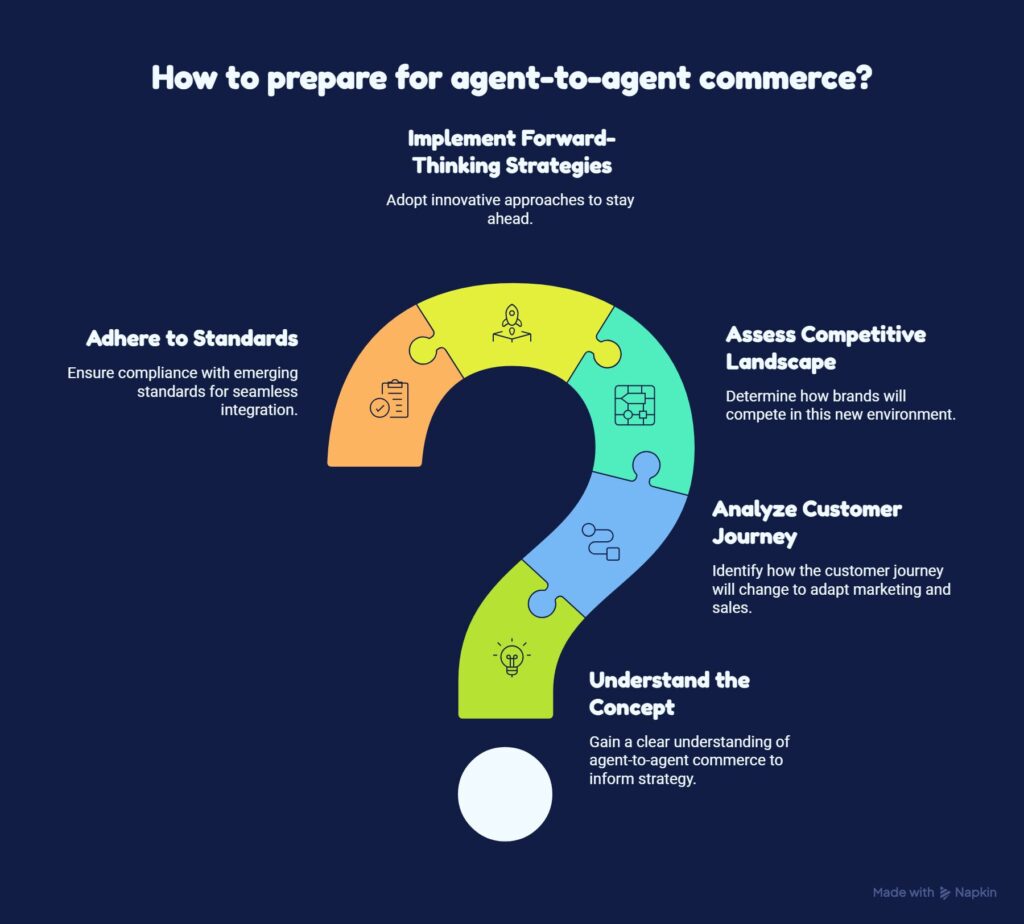
1. Cleaning up product data
AI agents can only recommend what they can read. Accurate, structured information on pricing, availability, specs and delivery is becoming the new shop window. Standards such as schema.org markup and JSON-LD help machines understand your catalogue without guessing.
2. Showing up in AI answers
Brands are testing what AI assistants say about them today. Ask the major assistants to recommend the best option in your category, then note what is missing, outdated or wrong. Those gaps become your to-do list.
3. Building signals AI trusts
Reviews, third-party mentions, clear policies and a consistent reputation all feed an agent’s decision. Credibility has always mattered, but now it has a machine audience too.
4. Preparing for agent-ready payments
Major payment players and tech platforms are developing protocols that let AI agents transact securely, including confirming that an agent is truly authorized to spend on a customer’s behalf. Google’s Agent Payments Protocol (AP2) and the Agentic Commerce Protocol from OpenAI and Stripe are two examples. Smart brands are watching closely and getting their checkout ready.
5. Rethinking loyalty and service
Loyalty programmes built on habit will need to be rebuilt on value. Service may also go agent-to-agent, with a customer’s agent contacting a brand’s support system to sort out a return or an issue.
The standards shaping agent-to-agent commerce
This is not a distant theory. McKinsey has projected that trillions of dollars in commerce could flow through AI agent orchestration by 2030.
Google’s Agent2Agent protocol is an open standard that lets agents communicate and coordinate securely, and it launched with support from more than 50 partners. Anthropic’s Model Context Protocol helps agents share tools and context. Platforms such as Shopify are positioning themselves as the connection point between merchants and AI agents.
Standards are being set and consumer expectations are forming right now. The brands that move early will help define what “agent-friendly” and “trustworthy” mean in their categories.
Questions to start building around
Use these three questions to start the conversation in your team:
- What does AI say about us when someone asks for the best option in our category?
- Is our product and pricing information accurate and easy for a machine to read?
- If an agent compared us to a competitor, what would tip the decision?
Frequently asked questions
- What is the difference between agentic commerce and agent-to-agent commerce?
Agentic commerce is the broader idea of AI agents shopping on a customer’s behalf. Agent-to-agent commerce describes the stage where the customer’s agent deals directly with a brand’s agent or systems.
- How can my brand prepare for AI shopping agents?
Start with accurate, structured product data, check what AI assistants currently say about you, and strengthen your reviews, policies and third-party mentions.
The next battleground in commerce will likely be the conversation between your customer’s AI agent and yours. Brands that structure their data, earn trust signals and prepare their systems now will be the ones agents choose.


